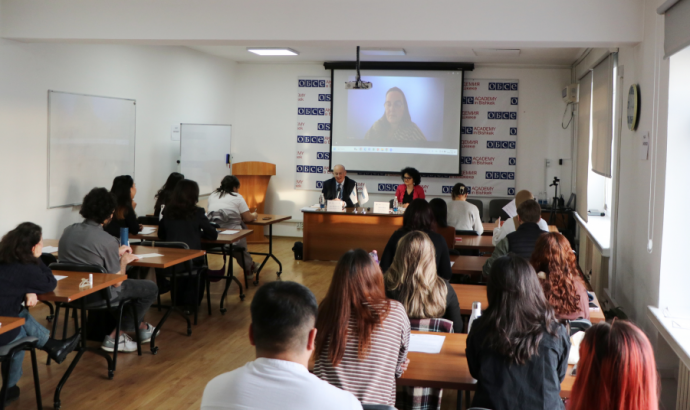
On 24 January 2026, a one-day workshop on Human Rights in Security-related Contexts was held at the OSCE Academy, bringing together 25 MA students of Politics & Security and Human Rights & Sustainability classes, both from the 2024-2026, and the 2025-2027 cohorts, to explore key human rights challenges at the intersection of security, religion, counter-terrorism, and emerging technologies.
The workshop was organized by the OSCE Office for Democratic Institutions and Human Rights (ODIHR), and supported by the Global Campus Central Asia and Right Livelihood. The event aimed to foster critical reflection and practical understanding of international human rights standards, with particular attention to children’s rights and the role of youth in Central Asia.
Opening remarks were delivered by Dr. Pal Dunay, Director of the OSCE Academy, Dr. Anja Mihr, Academic Director of the MA in Human Rights and Sustainability (MAHRS) Programme at the OSCE Academy (online); and Ms. Delia Nita, Associate Officer on Freedom of Religion or Belief at OSCE/ODIHR.
The workshop began with an introduction to the work of ODIHR’s Human Rights Department, presented by Mr. Maximilian Scheid, Associate Human Rights Officer at OSCE/ODIHR. The session provided an overview of ODIHR’s programming across a wide range of thematic areas, including human rights in anti-terrorism efforts, freedom of assembly, torture prevention, gender and security, freedom of religion or belief, and human rights and new technologies.
The first two sessions focused on Freedom of Thought, Conscience, Religion or Belief (FoRB). Together with Ms. Nita and Ms. Indira Aslanova from the Research Center for Religious Studies at Kyrgyz Russian Slavic University, participants explored the legal framework of FoRB, its permissible limitations, and its practical application through case studies. Discussions addressed inclusive interfaith dialogue, the engagement of youth and women, and the relationship between FoRB and security-related concerns.
In the afternoon, attention turned to human rights in anti-terrorism efforts, with a session led by Mr. Scheid. Participants examined international standards governing counter-terrorism measures and assessed real-life scenarios to better understand the potential human rights implications of security policies and practices.
The final session addressed freedom of thought in the age of artificial intelligence, drawing on ODIHR’s publication “Think again: Freedom of thought in the age of artificial intelligence.” Facilitated by Ms. Nita, the discussion explored how AI — including generative AI and neurotechnologies — may affect thinking processes, autonomy, and human rights, particularly for children and young people. Participants reflected on both the risks and the potential of AI in promoting and protecting human rights.
The workshop concluded with closing remarks by Dr. Dunay. He mentioned the danger of continuing violations of human rights, and the risk of ignoring human rights by states that used to be their strong advocates. Dr. Dunay also underlined the importance of equipping young people in Central Asia with the tools to critically engage with human rights issues in an increasingly complex security and technological environment.