
News
Annual Security Conference 2025
On 25 and 26 November 2025, the OSCE Academy hosted its Annual Security Conference under the title “Coming of Age: Central Asia and the OSCE in a Shifting Security Landscape.” This year’s conference scale extended beyond Central Asia, gathering panelists from around the globe ranging from Canada to Germany, Italy to India.
The opening part commenced with welcoming remarks from Dr. Pal Dunay, Director of the OSCE Academy. H.E. Ambassador Dr. Volker Frobarth, Head of the OSCE Programme Office in Bishkek and Chairman of the Board of Trustees of the OSCE Academy, and Dr. Fabio Indeo from the University of Siena.
Dr. Dunay called the attention to that the perception of an existential crisis of the OSCE is underlined by three factors: 1. The current violation of the shared values of the organization, 2. Financial and operational weaknesses, 3. Absence of political leadership due to over-politicization, and the frequent abuse of the consensus rule by various participating states. It depends on the expectations whether we regard the current situation a crisis. If we expect the OSCE to be an effective conflict settlement mechanism, the perception of crisis may prevail, whereas if our expectations are limited to the OSCE as a diplomatic forum, the critical approach would be far less founded.
Ambassador Frobarth called the attention to that the CSCE/OSCE always had difficult times, i.e. the current situation is not unique. Shall we mention Afghanistan (1979-89), the martial law in Poland (1981-1983), and several other cases up to our time epitomized by the war of Russia against Ukraine. The history of the organization combines the tradition of a conference with operational capacity.
The addresses were followed by the keynote presentation from Dr. Alexander Wolters, Visiting Lecturer and Former Director at the OSCE Academy, titled Filling the Void: Central Asian Agency and the OSCE. Dr. Wolters called for a more coordinated Central Asian voice within OSCE structures by “leveraging their strengthened regional cooperation, their new agency, and advance region-specific context within the OSCE, thereby filling the existing void.” Dr. Wolters called the attention to that a Euro-centric view prevails in the OSCE while Central Asia has remained under-contextualized on the agenda of the organization. It is another major challenge that a strategic narrative is absent on Afghanistan in the OSCE. The water deficit issue has gained attention but it is also often seen through European eyes. In sum, the OSCE should understand Central Asia better whereas the region should provide for a higher collective profile.
The two-day conference featured six panel sessions on the following themes:
1. “The OSCE at a Crossroads: Evolving Approaches to Security, Diplomacy, and Engagement in Central Asia,” moderated by Dr. Shairbek Dzhuraev, Deputy Director of the OSCE Academy. Presenters emphasized that where the OSCE shall make a difference is to avert conflicts and build trust quietly. Europe should act to avoid a fallback to great power dominance rather than rely on a more diverse basis.
2. “Regionalism, Afghanistan & Political Change,” moderated by Dr. Eleonora Pennino from the University of Siena. Speakers called the attention to the level of inequality across borders that is the sharpest between Kazakhstan and Kyrgyzstan based on per capita GDP, and the smallest between Kyrgyzstan and Tajikistan. It is essential to find ways of interactions beyond governments, including cooperation among local actors. A “reduced copy” of the EU Interreg funding programme should be introduced. Although there are very reassuring signs of cooperation in the region since 2017, it should not be induced by outside actors but the states of the region themselves. The various and numerous C5+1 frameworks or the forthcoming C5+5 framework can further foster intra-regional cooperation.
3. “Connectivity, Competition, and Cooperation: Central Asia in the Evolving Eurasian Security Landscape,” moderated by Dr. Sebastian Mayer, DAAD Associate Professor. The planned China-Kyrgyzstan-Uzbekistan (CKU) railway connection was discussed, calling the attention that it will present the biggest change for Kyrgyzstan as far as the length of railway lines. It is also a question how CKU will contribute to delivering and thus trading Kyrgyz goods and not be only used for transit. Youthful populations of Central Asia can serve as capital when so many countries suffer from shortage of manpower and ageing populations further to the north and west.
4. “Water, Agriculture & Environmental Security in Central Asia,” moderated by Dr. Emil Dzhuraev, Senior Lecturer at the OSCE Academy. Presenters called the attention to that one-third of glaciers have already melted, and in some cases even more in Kyrgyzstan, that indicates severe forthcoming problems. Less water, unless the states of the region work very closely together and regard the Amu Darya basin as a single system for shared and equitable use. They may also have to consider reliance on less water intensive cultures. Uzbekistan and Turkmenistan will face even more soil salinization than nowadays. The number of identified ecological violations has steadily increased in Kyrgyzstan. Still, the fines collected not cover the overall damage. One presenter called the attention to that there will never be “a post-agricultural world”.
5. “Human Rights, Security & Justice,” moderated by Dr. Fabio Indeo, focused on certain specific issues related to the right to a healthy environment and the role of the state to provide for it. Another presentation called the attention that the rules of the Convention on the Elimination of All Forms of Discrimination Against Women seems to fail delivering on incarcerated women that may be influenced by the distance between the national laws and their implementation / enforcement as well as elements of the Soviet legacy in law enforcement.
6. “Terrorism, Digital Borders & Hybrid Threats,” moderated by Dr. Milena Marzovilla from the University of Siena discussed the challenge of repatriating and prosecuting foreign terrorist fighters at a time when ISIS regains its activity. In such a case it is particularly important to repatriate trafficked youngsters who are trained into becoming fighters and women who in some cases did not commit crimes or served in the police forces in territories that were controlled by ISIS. Another presenter analyzed the increasingly pragmatic approach of various states towards the Taliban in Afghanistan. Although except for the Russian Federation, recognition has not been extended to the Taliban government, Turkmenistan and Uzbekistan pragmatically cooperate with it, including trade. Uzbekistan’s role is crucial as it controls the railway line going to Afghanistan and trades electricity with is southern neighbor. It is open to question whether rail connection will be established between Turkmenistan and Afghanistan and whether the Turkmenistan – Afghanistan – Pakistan – India (TAPI) pipeline will be realized under the current conditions in Afghanistan.
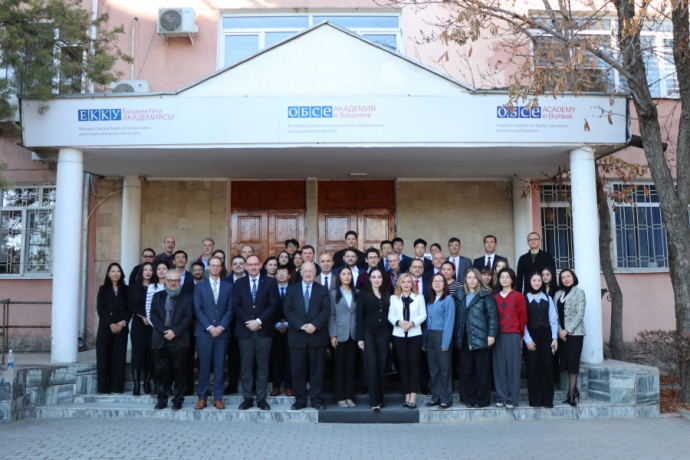
Together with the presenters, the conference convened around 60 participants in the Conference hall of the Academy, fostering an environment for thought-provoking questions and discussions.
The conference was ended by Dr. Dunay and Dr. Shairbek Dzhuraev, who expressed their gratitude to participants for their valuable insights and collaborative efforts in tackling these critical security challenges. Dr. Dunay expressed the satisfaction of the OSCE Academy with the intellectually enriching presentations, the forward-looking exchanges. He also urged researchers and experts to further "document" the outcomes of the presentations and discussions in written form for inclusion in the OSCE Academy’s collection of publications.
The Conference was co-organized by the University of Siena and is generously funded by the Norwegian Institute of International Affairs (NUPI) – the OSCE Academy’s distinguished donor, partner, and member of the Academy’s Board of Trustees.

 Русская версия