
News
OSCE Academy Hosts Guest Lecture by Professor Won-Gyu Hwang
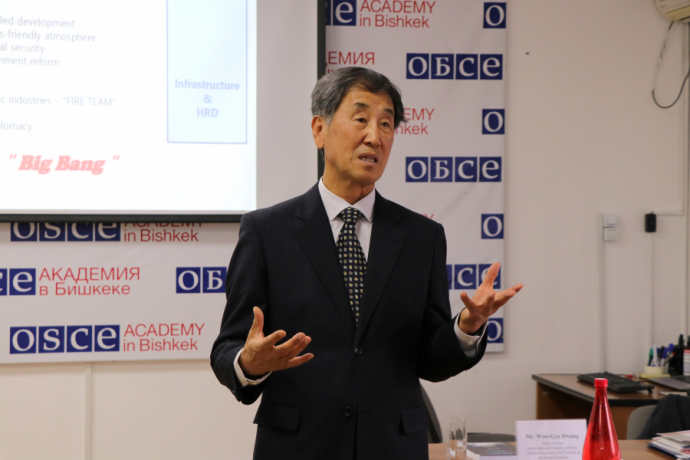
On 4 December 2025, the OSCE Academy hosted Professor Won-Gyu Hwang, Policy Advisor at the National Academy of Public Administration under the President of the Kyrgyz Republic (APAPKR), for a guest lecture on long-term economic development strategies for the Kyrgyz Republic. Prior to the event, Professor Hwang was welcomed in the Academy’s library by Dr. Pal Dunay, Director of the OSCE Academy. During the brief meeting, Dr. Dunay introduced the Academy’s history, academic programmes, and ongoing research activities, providing Professor Hwang with an overview of the institution’s mission and contributions to Central Asia.
Following the meeting, Professor Hwang delivered his presentation “Change Lanes: Alternative Development Strategies for the Kyrgyz Republic (2025–2075)” to BA students and the faculty. The presentation was based on Professor Hwang’s monograph, a copy of which he donated to the OSCE Academy's library. The lecture addressed key questions regarding the country’s future economic trajectory, including how the Kyrgyz Republic can accelerate growth, catch up with more developed states, and formulate effective strategies for sustainable and inclusive development. Professor Hwang outlined the logic and methodology of economic planning, introduced relevant benchmarking models, and discussed the appropriate role of government in shaping long-term progress. He emphasized the importance of turning Kyrgyzstan into a “hub state”, and emphasized how the Republic of South Korea went through a decades-long transformation and has become a highly developed industrial hub. Professor Hwang mentioned four conditions of success:
- Full commitment of the national leaders/elites;
- Total mobilization of elites;
- Collective determination;
- Sacrifice and devotion of a generation. South Korea benefited from strategies that bridged over generations of leaders.
In the education sector, Professor Hwang put the emphasis on competitive higher education being decisive in the process. He recognized that it is difficult to gain political support to bearing the cost of transformation.
The session offered students a structured understanding of global development dynamics and encouraged strategic thinking in economic policy. Later, they had an engaging Q&A session with Professor Hwang on development priorities and potential policy approaches.

 Русская версия