
News
OSCE Academy & GC Central Asia Mark Human Rights Day with a Joint Workshop
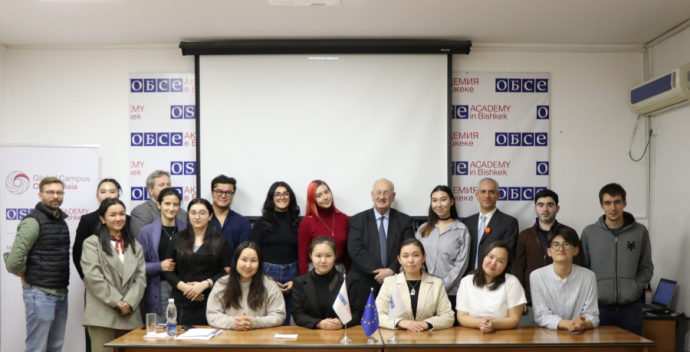
On 10 December 2025, the OSCE Academy and GC Central Asia hosted a workshop dedicated to Human Rights Day upon the anniversary of the Universal Declaration of Human Rights (UDHR). The event brought together international organizations, diplomats, and the student body to reflect on the UDHR 77 years after its adoption, and also provided an opportunity for students of the MAHRS programme to present their findings on Human Rights issues in the region.
The event commenced with an introductory Panel session on “Celebrating Human Rights 77 Years after the Adoption of the Universal Declaration of Human Rights” with keynote speakers. Dr. Pal Dunay, director of the OSCE Academy, opened the panel, declaring his “optimism in human rights, democracy, and the rule of law.” Dr. Dunay stated that “human rights will be more topical than ever” in light of the “challenges to human rights” caused by “self-proclaimed great powers.” He emphasized that human rights “will have to bounce back” if we are to call for “attention and activity to protect human rights,” as well as to be more vigilant about the “disappearance of the rule of law and the retreat of democracy”. Dr. Dunay then passed the floor to Prof. Manfred Nowak, the Secretary General of the Global Campus of Human Rights, who joined the event online. Prof. Nowak highlighted that the main achievement of the UDHR is a “synthesis between different human rights concepts,” referring to the contribution of Western, Social, and Global South concepts, so it is not a „Western document”. Further, the floor was given to H.E. Amb. Antje Grawe, UN Resident Coordinator to Kyrgyzstan, who brought the attention to the conclusion of the “16 Days of Gender-Based Violence campaign” and to the theme of the 2025 Human Rights Day, which is “Human Rights: Our Everyday Essentials.” She claimed that “young people and academia play an extremely important role in translating human rights into everyday life”. The next keynote speaker was H.E. Amb. Dr. Volker Frobarth, Head of the OSCE Programme Office in Bishkek, with his thematic speech on “The OSCE’s Role in Supporting and Promoting Human Rights”. Amb. Frobarth stated that “human rights have shaped the spirit of the Helsinki Final Act and remain at the core of the OSCE”. H.E. Rémi Duflot, Ambassador of the European Union to the Kyrgyz Republic, followed him. He mentioned that “Human rights are not abstract principles, they are lived realities”, so it is not the “responsibility of a few”, but rather “all of us” are accountable. Mr. Fabio Piana, OHCHR Deputy Regional Representative, also kindly shared his insights. He recalled him being an MA student himself at the Global Campus of Human Rights in Venice, and advised MAHRS students to “make more use of the agencies here”, referring to the organizations such as the UN, the EU, the OSCE, have a Human Rights focus. The final keynote speaker was Dr. Anja Mihr, Academic Director of the MAHRS Programme, who joined online to talk about “Human Rights in Times of Backsliding of Democracy,”. Dr. Mihr reflected on how human rights are taught and applied and how understanding it is particularly important during “these dark moments in times of backsliding of democracies and erosion of human rights.” She stressed that resisting authoritarian tendencies requires cooperation, so “different parties and groups in countries have to actually join forces, build alliances or coalitions to counteract anti-democratic movements.”
The second panel session featured presentations by students of the MAHRS programme, focusing on contemporary human rights challenges in Central Asia. The session highlighted student research across a range of thematic and regional issues. Saikal Malik kyzy, a MAHRS student from Kyrgyzstan, presented on “Women's rights in Kyrgyzstan,” examining the current state of women’s rights and the persistent challenges they are facing as far as their protection and implementation. Yerke Yerkenkyzy from Kazakhstan followed with a presentation titled “Children's Rights in the Central Asian Region with a slight focus on their health and well-being,” drawing attention to the vulnerabilities children face and disparities in access to health and social services across the region.
The third presentation, “Rights of Vulnerable Groups in Central Asia,” was delivered by Mamatkazy Rasul uulu from Kyrgyzstan, who focused on structural inequalities affecting marginalized populations and the importance of inclusive human rights policies. The session concluded with a presentation by Eugenia Ricciotti from Italy entitled “AI and Human Trafficking in Central Asia,” which explored emerging risks linked to digital technologies as well as their potential role in prevention and protection efforts.
An open discussion followed each presentation, allowing participants to engage with the students’ analyses and reflect on the role of academic research and human rights education in addressing complex and evolving human rights challenges in Central Asia.

 Русская версия