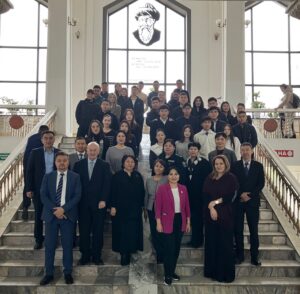
On 6 March 2026, Dr. Pal Dunay, Director of the OSCE Academy in Bishkek, participated in the Regional Conference “Education for Peace and Security,” dedicated to the International Day for Disarmament and Non-Proliferation Awareness. The event was organized by the Ministry of Foreign Affairs of the Kyrgyz Republic with the support of the Mission of the International Committee of the Red Cross in the Kyrgyz Republic and the OSCE Programme Office in Bishkek. The conference took place at the Kyrgyz State University and brought together diplomats, government officials, academics, experts, and young participants to discuss approaches to peace, security, and non-proliferation.
Moderated by Mr. Taalaibek Bektashev, Associate Director of the Center for Non-Proliferation and Export Control, the conference was opened with welcoming remarks by Dr. Alaibek Shamshiev, Vice-Rector of Kyrgyz National University named after Jusup Balasagyn, Dr. Pal Dunay, Director of the OSCE Academy, and Mr. Daniiar Kamalov, from the OSCE POiB. In his address, Dr. Dunay emphasized the importance of education and dialogue in responding to contemporary security challenges, noting that “international security is changing as we speak.” He also pointed out that earlier assumptions that Europe had entered a period dominated mainly by soft security approaches are now being reconsidered. As he explained, “cooperative security solutions seem to recede in a distance,” and today’s security environment increasingly requires addressing challenges through “a mix of hard and soft security.”
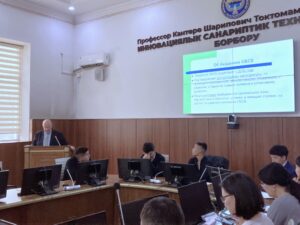
Dr. Dunay also contributed to the introductory plenary session dedicated to the purposes and educational mission of the International Non-Proliferation Awareness Day. In his presentation, he highlighted the role of the OSCE Academy in Bishkek as a regional platform for education, research, and dialogue on international security issues. He noted that the Academy brings together students from Central Asia and other OSCE participating States and offers graduate programmes in Politics and Security, Economic Governance and Development, and Human Rights and Sustainability. By connecting scholars, policymakers, and young professionals from across the region, the Academy contributes, among others, to discussions on disarmament, non-proliferation, and international security cooperation.
Referring to the broader international context, Dr. Dunay also warned about emerging risks related to nuclear weapons and the weakening of long-standing norms surrounding their use. “We have seen a decline of the nuclear taboo,” he said, noting that references to nuclear weapons have become more visible in the political discourse. In this context, he cautioned that “the danger of escalation to a conflict with the use of weapons of mass destruction is clearly visibly present.”
The one-day programme continued with thematic discussions on international cooperation in non-proliferation, the interaction between academic research and policy practice, and the development of educational programmes that prepare specialists in international security and export control. The conference highlighted the role of higher education institutions and international partnerships in fostering dialogue, raising awareness, and preparing future experts capable of addressing evolving global security challenges.