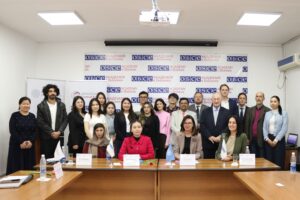
On 6 March 2026, the OSCE Academy in Bishkek and Global Campus Central Asia hosted a discussion event titled “International Women’s Day: Gender Issues in Central Asia.” The event brought together representatives of international organizations, academics, students, and alumni to discuss challenges related to gender equality, women’s rights, and the role of education in advancing inclusive and secure societies.
Opening the event, Dr. Pal Dunay, Director of the OSCE Academy, noted that despite progress, challenges remain: “Central Asia is a region where the human rights record is changeable and by far not fully satisfying.” He also stressed that gender equality provides an important entry point for improving human rights conditions more broadly.
The keynote session featured speakers from international organizations working on gender equality and women’s empowerment.
The first speaker was Mr. Christopher Blair, Head of the Human Dimension Department at the OSCE Programme Office in Bishkek, who presented the OSCE’s work promoting human rights and social inclusion. He emphasized, “You cannot have true security without human security, without human rights.” Mr. Blair highlighted initiatives by the OSCE in which women’s participation is central, such as long-term cooperation with the Kyrgyz Association of Women Judges, which works to advance equal access to justice and professional development within the judiciary. He also discussed the OSCE’s training of women leaders and politicians in rural Kyrgyz regions on how to run for elections, as well as its work addressing gender-based violence, where the OSCE contributed to increasing the capacity of state authorities to respond to domestic violence cases.
The second keynote speaker, Dr. Syed Sadiq, Country Representative of UN Women Kyrgyzstan, focused on the challenge of translating gender equality commitments into tangible outcomes in his presentation “Bridging Policy and Practice: Delivering Justice for Women and Girls.” He highlighted persistent global inequalities in women’s legal and economic rights, noting that “women and girls have just 64 percent of the legal rights of men.” Dr. Sadiq also pointed to economic disparities, observing that “in Kyrgyzstan… there is a 30 percent wage gap between women and men officially.” At the same time, he emphasized recent progress in women’s political participation and leadership, including the increase of women’s representation in parliament and new national targets aimed at expanding women’s presence in leadership positions across government institutions. He stressed that closing these gaps requires stronger implementation of laws, institutional accountability, and coordinated efforts by governments, civil society, and international organizations.
The third keynote panelist, Ms. Ana Dautovic, Deputy Representative of UNICEF, spoke about the role of education and empowerment, highlighting how investing in girls’ education benefits both individuals and society. She noted, “Kyrgyzstan is an extremely young country… young people below the age of 25 make up nearly half of the population.” According to Ms. Dautovic, ensuring equal opportunities for both girls and boys is essential to unlocking this potential.
The keynote segment concluded with the contribution of Ms. Aigerim Toktogulova, National Project Officer of the Women in Leadership (WIN) project at the OSCE Programme Office in Bishkek. Her presentation focused on initiatives that promote leadership opportunities for young women and encourage their participation in decision-making processes. She highlighted the importance of engaging young people directly in discussions on gender equality, noting that “students make it special… there are a lot of great ideas that we learn here from you students.”
The second part of the programme featured a panel discussion moderated by Dr. Dunay, where OSCE Academy students and alumni presented research addressing gender-related challenges in Central Asia and beyond. The presentations highlighted issues ranging from early marriage and women’s political participation to refugee experiences and international legal frameworks protecting women’s rights.
Ms. Aiperi Boronbaeva, MA in Human Rights and Sustainability (MAHRS) student 2025-2027, presented her research on Early Marriage in Kyrgyzstan: Challenges and Progress for Girls’ Right to Education. Her presentation examined how early marriage affects girls’ educational opportunities and long-term development. According to her research, girls who marry below the age of 18 often lose access to education, career opportunities, social life, and personal independence. Ms. Boronbaeva also highlighted the human impact of early marriage through personal testimony from a young woman who reflected on her lost educational opportunities: “If I could go back in time, I would refuse to get married… I should go and complete my studies.” At the same time, her research pointed to positive developments in Kyrgyzstan, including legal reforms setting the minimum marriage age at 18, the criminalization of forced marriage and bride kidnapping, and national initiatives aimed at keeping girls in school and promoting awareness about girls’ rights.
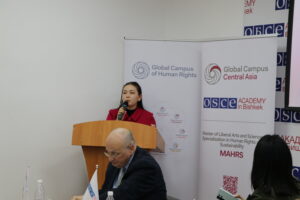
Ms. Maryam Nesar, MAHRS Alumna 2026, addressed the global crisis of child marriage in her presentation “Stolen Futures: The Global Crisis of Child Marriage and Afghanistan’s Lost Generation.” She explained that child marriage, defined as marriage before the age of 18, remains a widespread violation of children’s rights worldwide. According to her research, approximately 640 million women globally were married as children, and around 12 million girls become child brides each year. Ms. Nesar also discussed the situation in Afghanistan, where economic hardship, conflict, and restrictions on girls’ education have intensified the problem. Since 2021, more than one million girls have been banned from secondary education, increasing the pressure on families and raising the risk of early marriage.
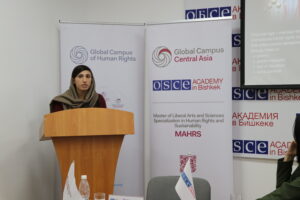
The third presentation by Ms. Darya Vasilenko, MAHRS Alumna 2026, examined the implementation of the Convention on the Elimination of All Forms of Discrimination Against Women (CEDAW) in Kazakhstan. Her research assessed how Kazakhstan has implemented the CEDAW Committee’s 2019 concluding observations between 2019 and 2025. Ms. Vasilenko’s findings suggest that while the country has introduced important legal reforms, progress has largely focused on formal legal measures rather than practical institutional change, leading to gaps between policy commitments and real-life outcomes. Her analysis also identified structural barriers that limit effective implementation, including weak enforcement mechanisms, fragmented institutional coordination, and persistent informal norms that reinforce gender inequality.
Finally, Ms. Shokhista Kayumova, MAHRS student 2025-2027, presented a project documenting the experiences of Afghan refugees in Central Asia titled “Between Lands and Lives: Testimonies of Afghan Women and Men Refugees in Central Asia.” Based on interviews with refugees in the region, the project highlighted both the challenges refugees face and their contributions to host communities. According to the research, Afghan refugees often encounter obstacles such as language barriers, limited employment opportunities, legal uncertainty, and discrimination. At the same time, the project emphasizes the resilience and contributions of refugee communities, including their work in education, healthcare, and community support initiatives.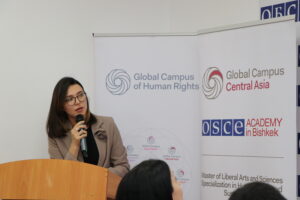
The event concluded with an open discussion among participants, emphasizing the importance of education, research, and international cooperation in advancing gender equality and supporting women’s leadership in Central Asia.