
On 25 March 2026, the OSCE Academy in Bishkek welcomed H.E. Feridun H. Sinirlioğlu, the Secretary General of the OSCE during his official visit to the Kyrgyz Republic. The visit to the Academy was part of the Secretary General’s programme in Bishkek, where he met with national authorities, including the President of Kyrgyzstan, H.E. Sadyr Japarov, and representatives of the OSCE community to discuss regional cooperation and the OSCE’s engagement in Central Asia. Secretary General Sinirlioğlu was accompanied by H.E. Ambassador Salman Bal, Liaison Officer of the Swiss OSCE Chair at the OSCE Secretariat, H.E. Ambassador Dr. Volker Frobarth, Head of the OSCE Programme Office in Bishkek (POiB) and H.E. Ambassador Siroco Messerli, Ambassador of Switzerland to the Kyrgyz Republic. Ms. Seraina Petersen, Senior Policy Support Officer of the OSCE Conflict Prevention Centre, Mr. John DiPirro, Senior Political Adviser, Mr. Colin McCullough, Senior Planning and Coordination Officer, and Mr. Atai Moldobaev, National Political Officer of the POiB.
Upon arrival at the OSCE Academy, guests were welcomed by Dr. Pal Dunay, Director of the Academy, as well as faculty members and five students representing the various programmes of the Academy. Following photographs taken with a large cohort of the student body, the delegation proceeded to the Academy’s library, where the meeting took place. After welcoming the guests, Dr. Dunay passed the floor to the Secretary General. H.E. Sinirlioğlu who delivered opening remarks and highlighted the importance of peace also in the area of operation of the OSCE. After the Secretary General, H.E. Ambassador Messerli also welcomed the OSCE Delegation and reflected on Switzerland’s active engagement in the OSCE, including its current Chairpersonship of the organization, as well as Switzerland’s long-standing support to the OSCE Academy in Bishkek.
Dr. Dunay summarized the situation of the Academy, highlighting the Academy’s role as the longest-standing implementing partners of the OSCE and an important platform for education and dialogue in Central Asia. The briefing included an update to the guests concerning the achievements and problems since the first opportunity the Academy had to brief the Secretary General in January 2025. The director of the Academy emphasized that the institution has been going through consolidation since 2024, including the retention of demand for the three MA programmes, with approximately 16-17 application per student. The three MA programmes reflect the three main dimensions of the OSCE, the politico-military, economic-environmental, and human dimensions. The budget of the Academy has been consolidated with a focus on the core educational programmes, the alumni community, and publications, while other, complementary activities are contingent upon external funding. The number of employees has been reduced from 39 to 32 while departures of employees from the Academy moved from 9 in 2024 to 4 in 2025, and as of the end of April (due to the one month notice an employee should give about the intention of termination) to zero in 2026. The internal stability with highly qualified employees is an asset of the Academy. The budgetary situation faces the challenge that as of now only six OSCE participating States contribute to the Extra-budgetary funding of the Academy. Dr. Dunay expressed the Academy’s gratitude for the contribution of the OSCE through the unified budget.
Secretary General Sinirlioğlu called the attention to the importance of visibility of the OSCE Academy among the participating States, the more active presence in Vienna to keep the delegations informed about the work carried out at the Academy in Bishkek.
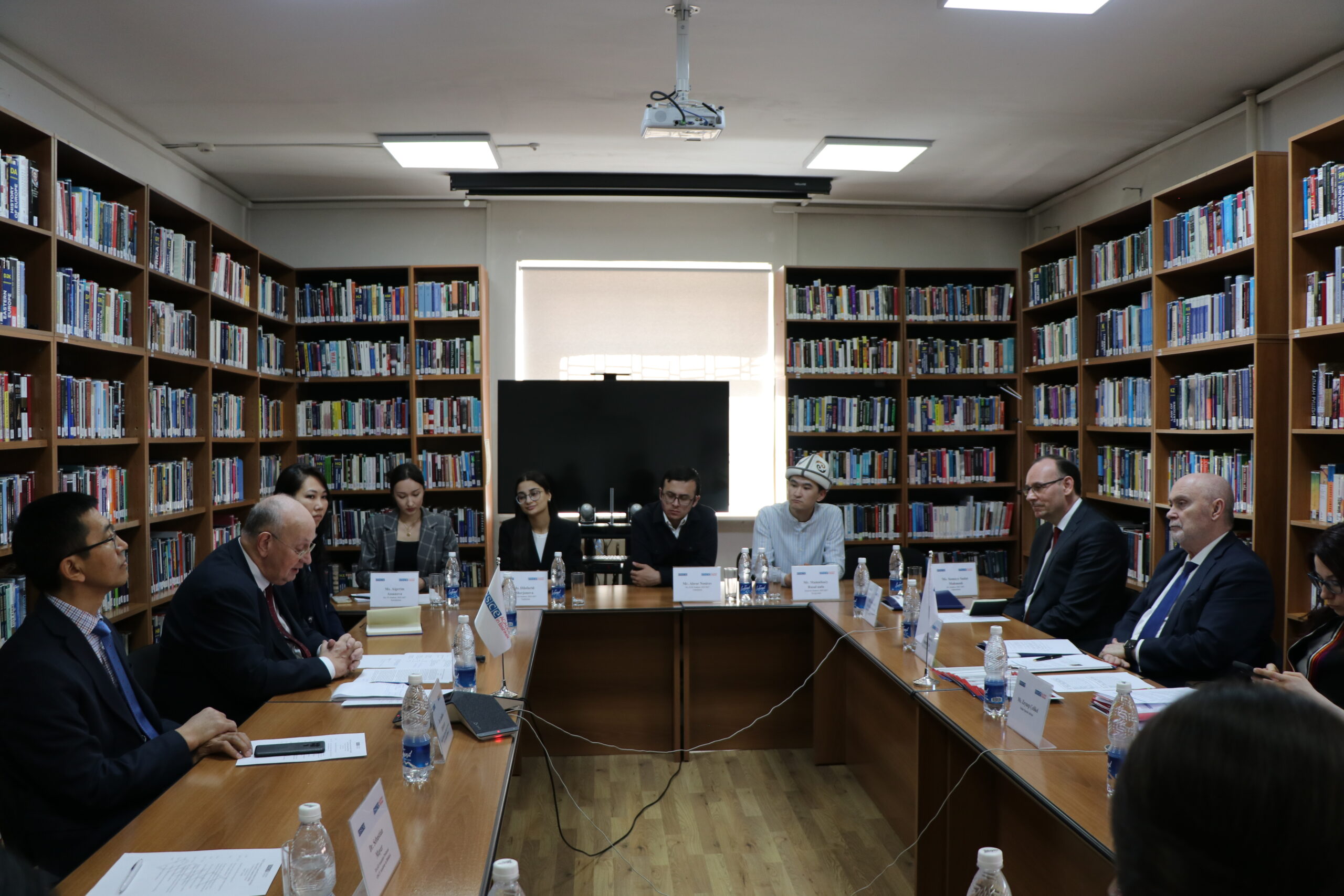
The meeting continued with short introductions by the students and faculty members. Students shared their experiences studying at the Academy, while faculty members introduced the institution’s academic programmes and research activities. The presentations were followed by an interactive discussion and exchange with the Secretary General and members of the delegation. Questions posed by the guests, students and faculty extended to matters, like some disbalance in the presence of the five nations in the student body among the seven states (five Central Asian countries, Afghanistan and Mongolia), the gender balance in the alumni community, and the work of the OSCE as an international organization under the current, difficult political conditions.