
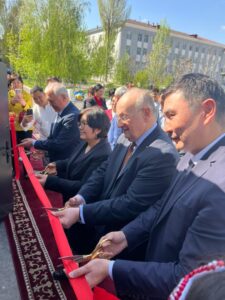
On 6 April, the Director of the OSCE Academy, Dr. Pal Dunay, together with Dr. Burulcha Sulaimanova, Head of the Research and Training Department at the OSCE Academy, participated in the opening ceremony of the Renewable Energy Research and Training Centre at Kyrgyz State Technical University (KSTU) in Bishkek. Dr. Dunay, who is also a member of the Advisory Board of the Bulan Institute, participated in the opening together with the Rector of the University, Dr. Mirlan Chynybaev, the Deputy Minister of Higher Education, Science, and Innovation, Dr. Bekbosun Borubashov, and the Director of the Bulan Institute, Ms. Cholpon Orozobekova. The Centre has been co-established by the Bulan Institute and KSTU, and funded by Swiss foundations.
In his contribution, Dr. Dunay emphasized that the transformation of the energy sector requires the coexistence of various factors: 1. Kyrgyzstan needs the technology to carry out the change. It must be made available, accessible, and affordable. 2. It requires to have professionals who can lead those changes, who gain and then have the technical knowledge and expertise. However, this is conditioned by directing expertise to projects, which address the issues competently and in their complexity. 3. The country also needs capital to achieve change. However, this requires establishing interest in using renewable energy sources. If it is cheaper to use solar energy, the shift will come. It requires that upfront investment would not be prohibitively high for the local population, including outside the cities. Here, regulatory issues and economic interests emerge. Among the regulatory issues, it is necessary that energy decentralization would be fostered by the Kyrgyz state. It requires a change of attitude and a nuanced regulatory environment that was not easy to achieve in richer and more decentralized states either. It is sufficient to mention Germany as an example that faced difficulties with returning solar energy to the central electricity distribution system. However, the geography of Kyrgyzstan may help people understand: Local electricity generation is advantageous. Capital should be allocated, be it national or foreign to motivate people to consider the change.
It is understandably not easy to address the matter of transition towards a larger share of solar and wind as energy sources when the country is rich in water resources that can be used for clean electricity generation. However, it seems that occasionally more is said than done. Reliance on non-renewables continues to be high, the share of coal creates severe air quality problems. It is enough to open the windows in winter that was fortunately very mild this year to draw such a conclusion. Still, energy efficiency has improved, central heating is switched on later and switched off earlier, new buildings are better insulated than older ones. Many electric cars are running on the roads, including gradually more environmentally friendly buses, etc.
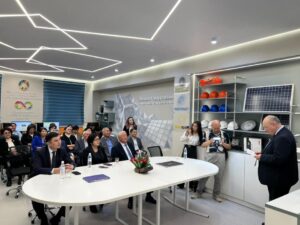
Dr. Dunay congratulated the Bulan Institute and the Kyrgyz State Technical University named after Iskhak Razzakov to take up this timely and important initiative and realize it.