
On 10-11 October 2026, the OSCE Academy in Bishkek hosted its annual Alumni Conference on “Central Asia in the New Era: Artificial Intelligence, Climate Change and Sustainable Development.” The two-day event brought together the Academy’s MA alumni, OSCE diplomats and experts for academic and policy exchange on regional challenges. This year’s conference was co-organized with the Office of the OSCE Representative on Freedom of the Media (RFoM).
The event was launched by remarks by Dr. Pal Dunay, Director of the OSCE Academy, who emphasized the importance of a vibrant alumni community, stating: “Your generation will soon be decisive in the further development of your countries, and in fostering region-building.” Following Dr. Dunay’s speech, H.E. Ambassador Dr. Volker Frobarth, the Head of the OSCE Programme Office in Bishkek and Chairman of the Academy’s Board of Trustees, highlighted “You are not simply graduates of the Academy, you are an essential part of its continued success and future development.” The event was opened by a keynote speech by Ms. Barbara Trionfi, Principal Adviser to the OSCE Representative on Freedom of the Media. Ms. Trionfi’s presentation titled “From Coverage to Impact: Promoting Stronger Climate and Environmental Journalism,” was based on her extensive experience in this area and evoked a lively discussion with participants.
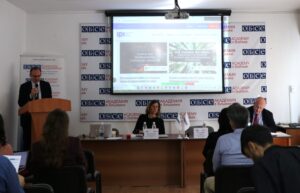

Three panel sessions featured alumni from Afghanistan, Kazakhstan, Kyrgyzstan, Tajikistan and Uzbekistan, representing different graduating years and MA programmes.
The first panel, “Climate Risks and Adaptive Capacity in Central Asia,” was moderated by Dr. Kuat Akizhanov, Deputy Director of the CAREC Institute and Visiting Lecturer at the OSCE Academy. Ms. Nazerke Mukhamediya presented “Transitioning Multi-Vectorism: Green Capital and Embedded Agency in Kazakhstan and Uzbekistan.” Ms. Niginakhon Uralova addressed Uzbekistan’s preparedness for climate-related internal migration, examining policy coherence across climate adaptation, migration and urban development. Mr. Qayoom Suroush joined online to present “Surviving the Border: Climate Stress and Informal Economies Across the Afghanistan-Central Asia Frontier.”


The second panel, “Climate Change and Sustainable Development in Central Asia,” was moderated by Dr. Shairbek Dzhuraev, Co-founder and President of Crossroads Central Asia and Visiting Lecturer at the OSCE Academy. Ms. Shoira Olimova’s presentation explored AI, climate change and civic space, focusing on community participation in sustainable development. Ms. Aiman Smagulova presented “Climate Reparations in the Central Asian Context.” Mr. Shamsurrahman Hamdard joined online to discuss economic and environmental shocks, food security and household resilience in Afghanistan, and their implications for climate adaptation and sustainable development.


The first day also featured a roundtable organized by the Office of the OSCE RFoM on Ministerial Council Decision No. 3/18, “Strengthening the Safety of Journalists and Implementing OSCE Media Freedom Commitments.” Moderated by Mr. Philippe Tremblay, Director of the Office of the OSCE RfoM. The session included an introduction by Dr. Dunay and online addresses by H.E. Ambassador Jan Braathu, OSCE Representative on Freedom of the Media, and H.E. Ambassador Andrea Cascone, Permanent Representative of Italy to the OSCE. The session addressed the RFoM mandate and implementation of the Decision, Italy’s role in its adoption, its connection to the Safety of Journalists project, and the role of National Focal Points, with presentations by Ms. Cecilia Lagomarsino of the RFoM Office and Ms. Salla Nazarenko from Finland.


The second day focused on “Artificial Intelligence and Governance in Central Asia,” moderated by Dr. Zhyldyz Tegizbekova, Senior Lecturer in the MA in Human Rights and Sustainability programme. Ms. Julia Haas, Adviser to the OSCE Representative on Freedom of the Media, and Ms. Begaim Usenova, Director of the Media Policy Institute in Kyrgyzstan, presented the OSCE Policy Manual on Safeguarding Media Freedom in the Age of Big Tech Platforms and AI and its regional implementation.
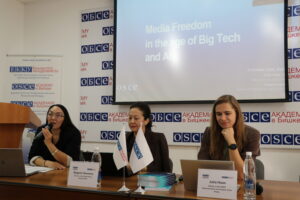
Mr. Eraj Sodatsayrov joined online to present lessons from the design of Tajikistan’s “Essentials of AI” secondary education curriculum. Ms. Assel Mussagaliyeva-Tang presented “Responsible AI for Central Asia: Building Public Capability, Trusted Infrastructure and Regional Readiness.” Ms. Gulzhan Begeyeva explored whether AI could disrupt “non-cooperative” regionalism in Central Asia, while Mr. Kodir Kuliev presented “From Perception to Proof: AI-Assisted Evidence for Measuring Control of Corruption in Central Asia.”


The conference concluded with closing remarks by Dr. Pal Dunay and networking lunch at the ethno-complex Supara.
The organization of the Alumni Conference was made possible through the generous support of the Norwegian Institute of International Affairs (NUPI).