
On 28–29 October 2026, the OSCE Academy in Bishkek, in collaboration with the Office of the OSCE Special Representative and Co-ordinator for Combating Trafficking in Human Beings, through its Supply Chains Project, and Global Campus Central Asia, hosted a seminar on “Addressing Trafficking in Human Beings and Labour Exploitation in Supply Chains.”
The seminar brought together students and alumni of the OSCE Academy’s Masters Programmes, alongside experts from academia, the OSCE Secretariat, civil society, international organizations and other relevant stakeholders. The event aimed to strengthen understanding of human trafficking for labour exploitation and forced labour, with particular attention to the challenges facing Central Asia and the wider OSCE region.
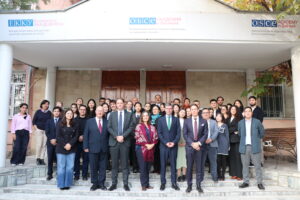
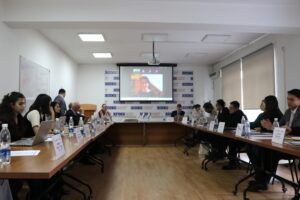
Trafficking in human beings has remained a serious human rights violation and a persistent challenge worldwide. Labour exploitation and forced labour are among its most prevalent yet often under-identified forms. Addressing these issues requires not only effective law enforcement, but also stronger labour protections, responsible business practices, ethical recruitment and improved governance of supply chains.
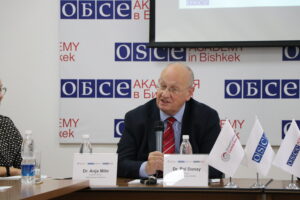
The event was opened by Christopher Blair, Head of Human Dimension at the OSCE Programme Office in Bishkek, Dr. Pal Dunay, Director of the OSCE Academy in Bishkek, and Dr. Anja Mihr, Academic Director of MAHRS Programme, Global Campus Central Asia. 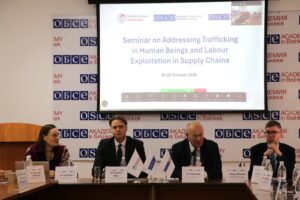
In his speech, Dr. Dunay underlined that “The trafficking in human beings is an important area of international security where the OSCE, due to its comprehensive agenda has great potential and can do a lot both inside the OSCE area and also consider the external pressure on many participating States. It can foster cooperation and exchange of views among the participating States and contribute to the efforts of some others.”
Through expert presentations, thematic sessions and panel discussions, participants explored the links between human trafficking, labour rights, business and human rights, and sustainable development. The programme also examines due diligence frameworks, victim protection and access to remedy, as well as practical approaches to preventing exploitation in supply chains.
The seminar featured contributions from international and regional experts, including Dr. Alexander Trautrims, Associate Director and Professor of Supply Chain Management at the University of Nottingham; Alessia Vedano, Adviser on Anti-Trafficking Issues at the OSCE Office for Democratic Institutions and Human Rights (ODIHR); Mariam Bhatti, a lived-experience expert and survivor serving on the OSCE’s International Survivors of Trafficking Advisory Council (ISTAC) Advisory Council, Dr. Tobias Seitz, Researcher and Policy Adviser at the German Institute for Human Rights, and David Camp, Founder and Chair, Association of Labour Providers; Founder and Chair, Stronger Together.
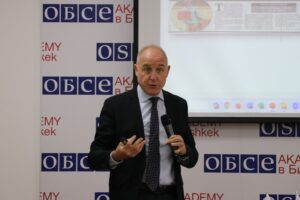
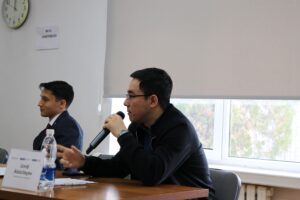
Sessions focussed on supply chains in Central Asia, forced labour and human trafficking in the region, labour exploitation, and the relationship between sustainable development and responsible supply chain management. By bringing together academic perspectives and policy experience, the event provided a platform for critical discussion, regional knowledge exchange and practical reflection on measures to prevent exploitation and strengthen human rights protections.
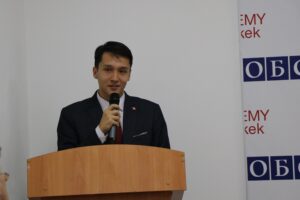
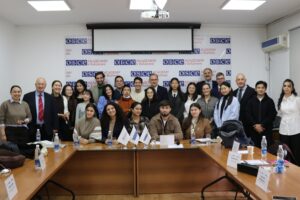
The seminar was organized within the framework of the extra-budgetary project “Prevention of Human Trafficking for Labour Exploitation in Supply Chains,” implemented with the financial support of the Governments of Germany, Austria, Norway, Finland and France.