
On 6 November 2026, the OSCE Academy in Bishkek hosted an online seminar titled “Labour Migration in Central Asia: Development, Governance, and Geopolitical Change.” The seminar examined how geopolitical developments are reshaping labour migration policies in the region and explored opportunities for regional cooperation. Dr. Pal Dunay, Director of the OSCE Academy, moderated the session.
Dr. Vladyslav Butenko, Associate Research Fellow at the OSCE Academy, delivered a presentation titled “Migration Governance under Geopolitical Pressure: How Central Asian States Adapt Labour-Migration Policies amid the Transformation of Russia-Centred Mobility Regimes.” He examined Central Asian countries’ dependence on labour migration to Russia and the challenges posed by changing migration regulations and geopolitical pressures. His presentation also addressed gaps in existing arrangements for protecting migrant workers.

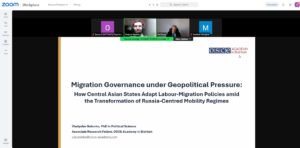
Dr. Butenko proposed a Central Asian Agreement on Labour Mobility and Social Protection to strengthen coordination among countries of origin. His recommendations included harmonising bilateral labour agreements, ensuring the portability of social rights, improving pre-departure training and diversifying migration destinations.
Mr. Matthew Heneghan, ESRC Doctoral Researcher at the University of Glasgow and Associate Research Fellow at the OSCE Academy, presented “Migration Diplomacy without Mobility? Central Asia and the Proxy Politics of Bilateral Labour Agreements.” He explored the political role of bilateral labour agreements and Central Asian states’ efforts to diversify migration destinations, alongside the region’s continued reliance on remittances from Russia. His presentation considered how these agreements regulate recruitment, employment conditions, social protection and return migration.


The seminar concluded with a question-and-answer session, allowing participants to discuss migration governance and the challenges facing Central Asian migrant workers with the speakers.