
On 25-26 June 2026, the OSCE Academy in Bishkek, with the support of the OSCE Programme Office in Bishkek and the Swiss Chairpersonship of the OSCE for 2026, organized its Annual Security Conference on the topic “Central Asia in a Fractured Eurasia: Intra- and Extra-regional Cooperation.” Over two days, participants explored the opportunities and challenges facing Central Asia amid growing geopolitical fragmentation, focusing on regional cooperation, water and energy governance, emerging C5+1 frameworks, and the role of the OSCE and its participating States in promoting dialogue and stability.
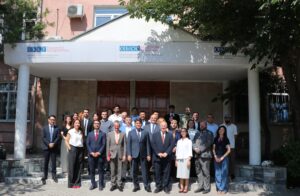
The conference was opened by Dr. Pal Dunay, Director of the OSCE Academy in Bishkek, who welcomed participants from academia, government, international organizations, and the diplomatic community. Dr. Dunay noted that the conference would provide an opportunity to examine the most significant developments shaping Central Asia, with discussions focusing on regional political, economic, energy, and water cooperation, as well as the growing role of emerging C5+1 formats.
Following him, H.E. Ambassador Melis Mamadaliev, Director-General of the Department of International Organizations, reflected on the current international environment, posing a central question for the conference: “How can states preserve stability, promote development, and protect their interests in an increasingly fragmented world?” He stressed that, for Kyrgyzstan, “the answer begins with multilateralism,” describing it not as an abstract concept but as “a practical necessity” that enables small and medium-sized states to ensure their voices are heard and that international relations are governed by rules rather than by power alone.
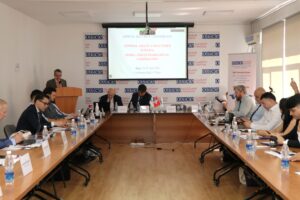
The next important remarks, on behalf of the Swiss Chairpersonship of the OSCE, were delivered by H.E. Ambassador Sirocco Messerli, Ambassador of Switzerland to the Kyrgyz Republic, who first congratulated the Kyrgyz Republic on its election as a non-permanent member of the United Nations Security Council for 2027-2028, reaffirming Switzerland’s commitment to multilateralism and its close partnership with Kyrgyzstan. Reflecting on the conference theme, Ambassador Messerli noted that “geopolitical fragmentation shapes our economies, it shapes access to resources, it shapes environmental risks, and ultimately also the opportunities available to people,” emphasizing that these challenges underscore the importance of dialogue and regional cooperation. Ambassador Messerli also praised the OSCE Academy, stating, “Supporting platforms like the Academy is not just about partnership; it’s investing in dialogue.” Reflecting on Switzerland’s 2026 Chairpersonship of the OSCE, Ambassador Messerli underlined the importance of strengthening dialogue at a time of growing geopolitical complexity and supporting Central Asia as it navigates an increasingly challenging international environment.
The opening ceremony concluded with the keynote speech by Dr. Dunay, who reflected on the evolving role of the OSCE in an increasingly fragmented Eurasian security environment. He noted that the Organization’s “performance should always be measured against expectations” and that judgments about the OSCE depend on whether it is expected to solve every regional security challenge or to serve as a forum for dialogue and cooperation.
Addressing the Organization’s role, Dr. Dunay stressed that “the OSCE can hardly be better than the participating States and their relations, and can hardly overcome their aspirations,” emphasizing that its effectiveness ultimately depends on the political will of its 57 participating States rather than on its institutional structure alone. He then observed that the region has entered a new stage of development. “The first phase of nation- and state-building has been completed in Central Asia a generation after the break-up of the Soviet Union,” he said, adding that “the states no longer focus on ‘who they are not,’ leading to exclusion, but may address more on what connects them.” According to Dr. Dunay, this creates new opportunities for regional cooperation and allows the OSCE to devote greater attention to supporting governance, institution-building, and the human dimension across the region.
Looking ahead, Dr. Dunay argued that the Organization should continue adapting to emerging security challenges, including climate change, natural resources, energy security, and the rights of women and children, while acknowledging that “the biggest challenge for the OSCE is that multilateral cooperation is lastingly contested, soft power is ignored, coercion often prevails, and the normative foundations are interpreted selectively by some participating States.” Despite these challenges, he concluded on an optimistic note, observing that although the OSCE has repeatedly faced periods of crisis throughout its history, “it kept the credit of its stakeholders and headed to better times.”
Following the opening ceremony, the conference continued with four thematic panel sessions that examined the political, economic, environmental, and geopolitical dimensions of regional cooperation in Central Asia. Bringing together leading scholars, policy analysts, diplomats, and practitioners from across the region and beyond, the sessions explored how shifting regional and global dynamics are reshaping patterns of cooperation and creating new opportunities for dialogue and integration.
Session I: Key Aspects of Cooperation Across Policy Fields
The first panel, moderated by Dr. Emilbek Dzhuraev, Senior Lecturer at the OSCE Academy, examined the evolving patterns of regional cooperation across political, economic and security dimensions. With this the first session laid the ground for studying select priority issues, like water and the C5+1 cooperation frameworks.
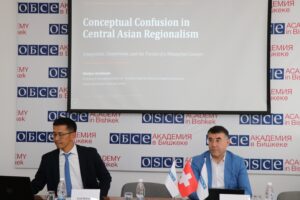
The session featured presentations by:
- Prof. Ikboljon Qoraboyev, Maqsut Narikbayev University (Astana) – Conceptual Confusion in Central Asian Regionalism
- Dr. Filippo Costa Buranelli, University of St Andrews – Intra-regional Economic Interaction: Trade and Investment
- Dr. Farkhod Aminjonov, National Defence College, United Arab Emirates – Political and Security Cooperation in Central Asia
- Dr. Nargis Kassenova, Davis Center for Russian and Eurasian Studies, Harvard University – Political and Security Cooperation: The Intra-regional Dynamics
Session II: Water and Energy: Essential Elements of Resource Sharing and Cooperation in Central Asia
Moderated by H.E. Ambassador Dr. Volker Frobarth, Head of the OSCE Programme Office in Bishkek, the afternoon session focused on the critical nexus of resource sharing and climate resilience.
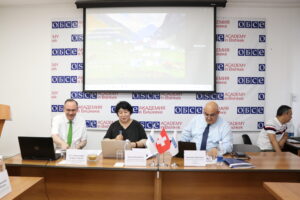
The session featured presentations by:
- Dinara Kemelova, Special Representative of the President of the Kyrgyz Republic on mountain regions development – Introductory Brief on Water, Energy and Mountain Development
- Thierry Umbehr, Head of section Caucasus, Central and East Asia, Swiss Agency for Development and Cooperation – Impressions from Water Co-operation in Central Asia Over the Past Decades
- Iskandar Abdullaev, Senior Researcher, International Water Management Institute (IWMI) – Reflections on Current Water Management and Policy-making Initiatives (p. 3)
- Tobias Siegfried, Hydrosolutions Ltd. – Solutions for Effective Use of Water Resources in Context of Climate Change
- Sven Ernedal, GIZ Programme Manager EU4SustainableCentralAsia: Renewable Energy in Central Asia (EURECA) – The Green Central Asia Initiative and Renewable Energy & Energy Co-operation in Central Asia
- Jenniver Sehring, Associate Professor of Water Governance and Diplomacy at IHE Delft – Bilateral and Regional Dynamics in Water Cooperation
Session III: Emergence, Variation, and Impacts of the C5+1 Frameworks
Chaired by Dr. Pal Dunay on the morning of the second day, this session examined the rise of external partnerships, including recent consultative expansions with external actors.
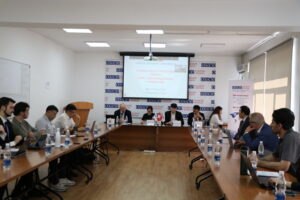
The session featured presentations by:
- Emilbek Dzhuraev, Senior Lecturer, OSCE Academy in Bishkek – Multiplex World Order and Central Asia’s Regional Multi-vectorism
- Nargiza Muratalieva, Associate Professor, American University in Central Asia (Bishkek) – Regionalism in Central Asia: Internal and External C5+1 Formats
- Eldaniz Gusseinov, Non-Resident Research Fellow at the Heydar Aliyev Centre for Eurasian Studies, Ibn Khaldun University (Istanbul) – The First Formal Framework of Interregional Cooperation with Central Asian Countries: The Case of the Arab Gulf States
Session IV: Central Asia as Seen by OSCE Participating States
The final afternoon shifted to the National Museum in Bishkek at Ala Too Square, introducing perspectives from diplomacy on Central Asia. Following an official welcome by H.E. Ambassador Pietro Lazzeri, Head of Economic Cooperation and Development at SECO, the high-level panel was moderated by H.E. Ambassador Siroco Messerli.
The panel featured interactive dialogues with:
- E. Mr. Meder Abakirov, Deputy Minister of Foreign Affairs of the Kyrgyz Republic
- E. Ambassador Mekin Mustafa Kemal Ökem, Ambassador of Türkiye in Kyrgyzstan
- E. Ambassador Monika Lenhard, Ambassador of the Federal Republic of Germany in Kyrgyzstan
- E. Ambassador Rémi Duflot, Head of the EU Delegation to Kyrgyzstan
- E. Ambassador Dr. Serge Rumin, Special Representative of the Swiss CiO for the Promotion of Dialogue and Confidence-Building
The conference concluded with the official opening of the Swiss Water Exhibit by Ambassador Pietro Lazzeri.
The conference summary will be available on the website of the OSCE Academy soon.
The OSCE Academy plans to publish collected essays based on the high-quality contributions of the panelists.