Dr. Sebastian Mayer, DAAD Associate Professor at the OSCE Academy, is currently undertaking a research stay at Lund University, Sweden, from 1 to 19 June as part of the Multilevel Orders of Corruption in Central Asia (MOCCA) research and training project funded by the European Commission. The MOCCA project, led by the Department of Sociology of Law at Lund University, investigates national and international efforts to understand and combat corruption through interdisciplinary research on multilevel corruption regimes in the five post-Soviet states of Central Asia. The OSCE Academy is one of the project’s partner institutions.
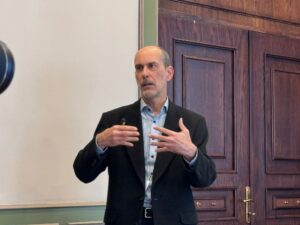
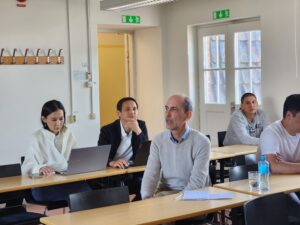
On 11 June, Dr. Mayer presented his book chapter entitled “The Central Asian Anti-Corruption Regime Complex” at a research seminar hosted by the Department of Sociology of Law at Lund University. The chapter forms part of an edited volume currently in press with Palgrave. It examines how eight international organizations engaged in anti-corruption efforts in Central Asia since the mid-1990s have evolved into an anti-corruption regime complex, focusing on its structure, patterns of interaction, and implications for governance effectiveness in the region.
During his research stay, Dr. Mayer was also appointed Research Stream Leader within the EU Horizon Europe research and staff exchange project Political Economy of Legal and Governance Reform in Non-Western Societies: Insights from Central Asia (POLCA). The project, funded under the Horizon Europe programme and supported through Marie Skłodowska-Curie Actions staff exchanges, is coordinated by Lund University and runs for four years starting 1 January 2026. It explores why rule-of-law and democratization reforms in non-Western contexts often fail to achieve intended outcomes, highlighting the role of alternative institutions and governance norms outside formal state structures.
Within POLCA, Dr. Mayer co-leads Research Stream 1 on International and Regional Norms, Initiatives, Discourses, and Institutions, which examines how international and regional norm entrepreneurs, including states, international organizations, and development agencies, shape governance transformations in Central Asia. On 11 June, he presented the research stream at a seminar in Lund and invited participants to contribute to future collaborative research within this framework.