
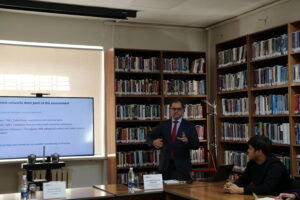
On 7 October 2026, the OSCE Academy in Bishkek hosted the seminar “Online Nihilistic Violence and Hybrid Radicalisation: Grievance, Online Spaces and Pathways to Violence,” by Przemyslaw Ozierski, Associate Research Fellow at the Academy and Senior Researcher at CASCADD.
Drawing on case studies, Mr. Ozierski presented the view that violence has become an ideology on its own. Mr. Ozierski examined how personal grievances, ideological hatred and online peer influence can intersect in pathways to violence. He stated that some platforms of online participation may give recognition to cruelty and coercion. It can be directed against other persons or against the person himself (Literature on encouragement to push somebody to commit suicide is available.) The presentation highlighted the role of belonging, recognition and the circulation of violent content within online communities.

The seminar outlined approaches to prevention, including assessing behavior alongside ideology, protecting vulnerable young people and addressing harmful content. It emphasized that gaming, loneliness or mental health difficulties alone do not establish a risk of violence.
Mr. Ozierski emphasized that while banning various social media platforms does not result in loss of access to the sources by those who are interested in the content they spread, it deprives the state authorities to moderating the messages and reaching out to the “audience” that uses them, e.g. through VPN. Hence such a “collective self-protection” of the state may not reach the desired objective. It increases the risks of violent acts as young perpetrators often give signals what they are planning to perpetrate. Banning access makes interference with the violence to be perpetrated far more difficult, if not impossible.